

Why Presence Is Becoming the Defining Leadership Skill of This Era
Leadership today is no longer defined by stability or certainty—it’s defined by volatility, speed, and sustained pressure.
Leaders today are operating inside an unprecedented storm.
Nonstop change.
Competing priorities.
Fragmented attention.
Emotional overwhelm.
Relentless pressure to do more with less.
Yet the issue facing leaders and high performers isn’t a lack of intelligence, ambition, or capability.
It’s a lack of training.
Specifically, training to remain present inside a world that is accelerating faster than human capacity to process it.
This article explores why presence-based leadership is emerging as one of the most critical skills for sustained performance—and why leadership, culture, and results are built not in outcomes or strategies alone, but moment by moment through how leaders show up in real time.
The short video below expands on the ideas explored in this article, offering a real-world example of how presence shapes leadership and performance in high-pressure environments.
The Problem: The Noise We’re Leading Inside
Most leaders aren’t failing.
They’re overloaded.
Their attention is fragmented.
Their internal bandwidth is maxed out.
Their best energy is spent reacting instead of creating.
They are:
- flooded with distractions
- pulled in multiple directions at once
- responding to disruption rather than shaping the future
Over time, this erodes the very qualities leadership depends on.
Calm disappears.
Clarity narrows.
Confidence wavers.
Connection weakens.
And without those, even the strongest strategies lose their power.
The real problem isn’t the pace of the external world.
The real problem is that our internal operating systems were never designed for this velocity.
External demands are accelerating.
Internal capacity hasn’t caught up.
The hard truth is this:
The external world isn’t the core issue.
Our internal one is.
The Shift: What Changes When Leaders Learn to Be Present
Now imagine a different lived experience.
Nothing about your external world changes.
Your calendar remains full.
The stakes are still high.
But your relationship to it shifts.
There is space inside the movement.
Stillness inside the urgency.
Clarity inside the noise.
Leaders begin to reclaim their attention.
They learn to respond intentionally rather than react automatically.
They start showing up fully in the moments that matter most.
Teams shift from:
- reactive → intentional
- fragmented → engaged
- burned out → energized
- distracted → focused
- overwhelmed → empowered
When leaders learn to lead moment by moment, something fundamental changes. They regain trust in themselves. They create space for clearer thinking. And they unlock the conditions required for real growth—purpose, creativity, calm, resilience, connection, and sustainable performance.
This is not about becoming slower or softer.
Presence is not soft.
Presence is the unlock.
High-Performance Leadership Is Built Moment by Moment
Leadership is not built in highlight reels.
It isn’t forged in titles, outcomes, or applause.
It’s built moment by moment—in quiet decisions, unseen conversations, and internal choices made when no one is watching.
Success is no longer a finish line to cross.
It’s the ability to remain grounded, focused, and intentional inside the process, especially under pressure.
The most effective leaders don’t just manage tasks.
They manage their state.
They lead with curiosity instead of reactivity.
With humility instead of ego.
With awareness instead of autopilot.
Because:
- trust is built moment by moment
- culture is shaped moment by moment
- belonging is created moment by moment
- performance is unlocked moment by moment
This is where transformation actually lives.
Not in someday.
Not in theory.
But in the now.
One breath.
One choice.
One conversation at a time.
Why Presence Drives Performance Under Pressure
When leaders learn how to:
- train their attention
- regulate their nervous systems
- stay present in real time
Everything changes.
Decision-making becomes clearer.
Communication improves.
Relationships deepen.
Performance becomes sustainable instead of draining.
This is the work beneath the work—the internal operating system that determines how leaders show up when the pressure is on.
Presence allows leaders to do more than survive volatility.
It allows them to lead through it.
The Outcome: Leadership That Holds Up Over Time
This shift doesn’t stay theoretical.
It shows up in meetings.
In conversations.
In how leaders respond when plans break, pressure spikes, or uncertainty rises.
Through simple, repeatable, moment-by-moment skills, strategies and mindsets, leaders learn to:
- stay grounded under pressure
- regulate attention and energy
- make intentional choices instead of reactive ones
- communicate with clarity and empathy
- do more with less time, energy, and resources
The result is a leader who shows up with steadiness, clarity, and conviction—and a team that mirrors that presence.
The outcomes organizations value most—engaged teams, strong performance, sustained focus, connection, belonging, and retention—are not strategies to install.
They are created—or eroded—by how leaders show up in the moments that matter.
Transcend the noise.
Win the moment.
Moment by moment.
Video Transcript: The Power of Presence (Keynote Excerpt)
The following is a lightly edited transcript included for accessibility, clarity, and reference.
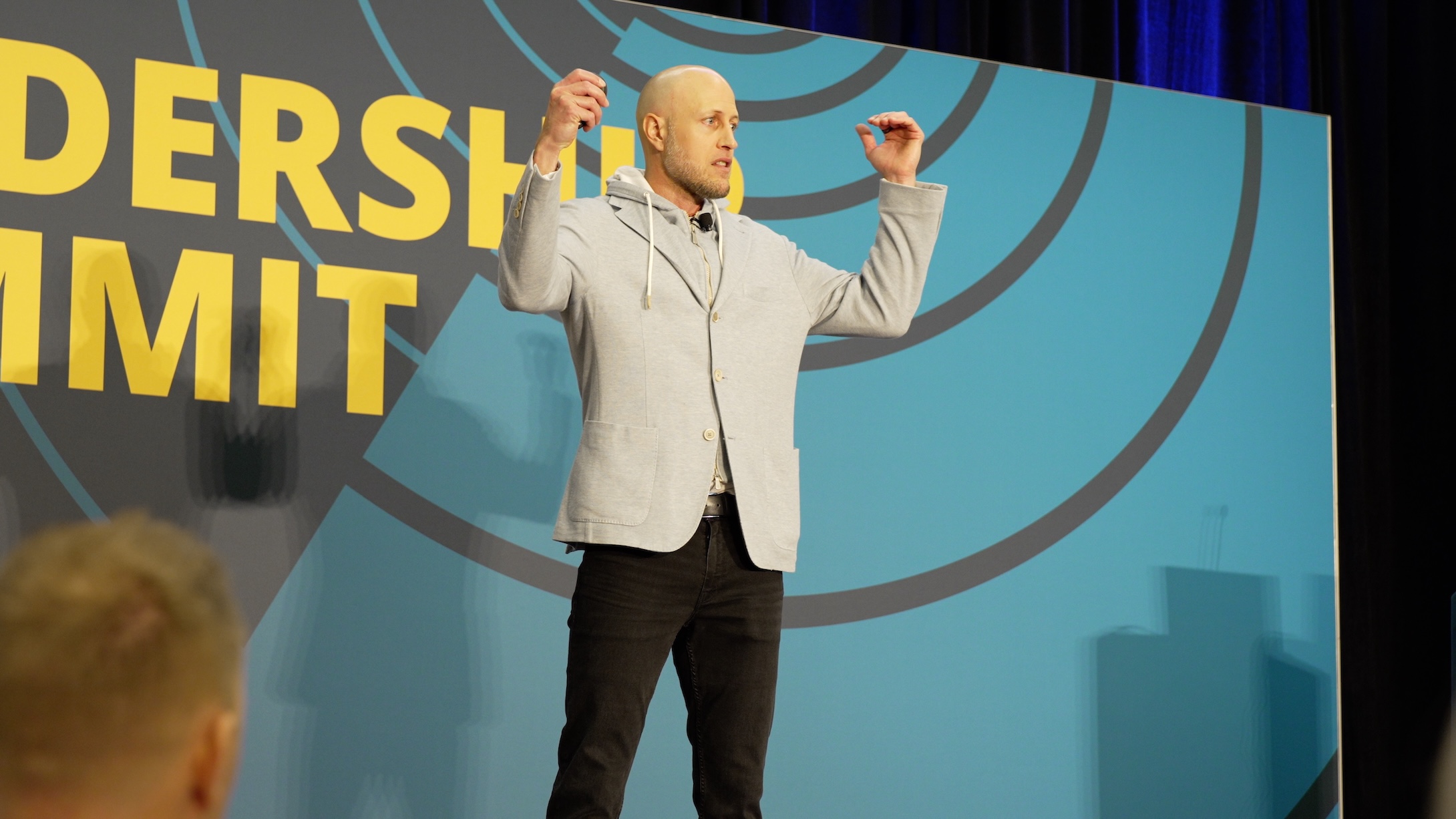
This keynote was delivered at the Boston Convention Center to more than 800 healthcare leaders, exploring how to unlock the potential of people, performance, and psychology through the power of presence.
There was a period in my life where I would move from laughter to tears, from calm to chronic anxiety, to debilitating depression—all within the span of a few hours. What this taught me, more than anything, was that in those emotional states, I could not access the present moment.
It was through that experience that I realized something foundational: everything we need to take our leadership and performance to the next level exists in the present moment.
One of the things that Kobe Bryant did better than anyone in his era was place his attention and energy fully into the present. His mind wasn’t in the past, replaying missed shots. It wasn’t in the future, worrying about the next one. He was completely locked into the moment he was in.
In environments filled with chaos, disruption, and constant change, the ability to find stillness becomes a real strength.
One of the quickest ways to access the present moment is through listening. By focusing on what we can hear, we naturally drop into the now. People don’t just want our advice or solutions—they want to feel our presence. And one of the simplest ways to offer that presence is to truly listen.
If organizations want to attract, engage, and retain top talent, they have to give people the gift of presence.
Purpose plays a critical role as well. Purpose—both at an organizational level and an individual level—creates a higher degree of intentionality in how we show up. Research shows that people with a clear personal purpose are three times more likely to stay engaged with their goals, and purpose-driven leaders are significantly more likely to retain their teams.
One of the most effective ways to cut through the noise and clarify purpose is a simple exercise: writing your own eulogy. Asking questions like: Who did I impact? What did I contribute? What do I want people to say about me when I’m gone?
When we gain clarity on those answers, it changes how we show up in the present moment—because purpose creates intention, and intention shapes leadership.