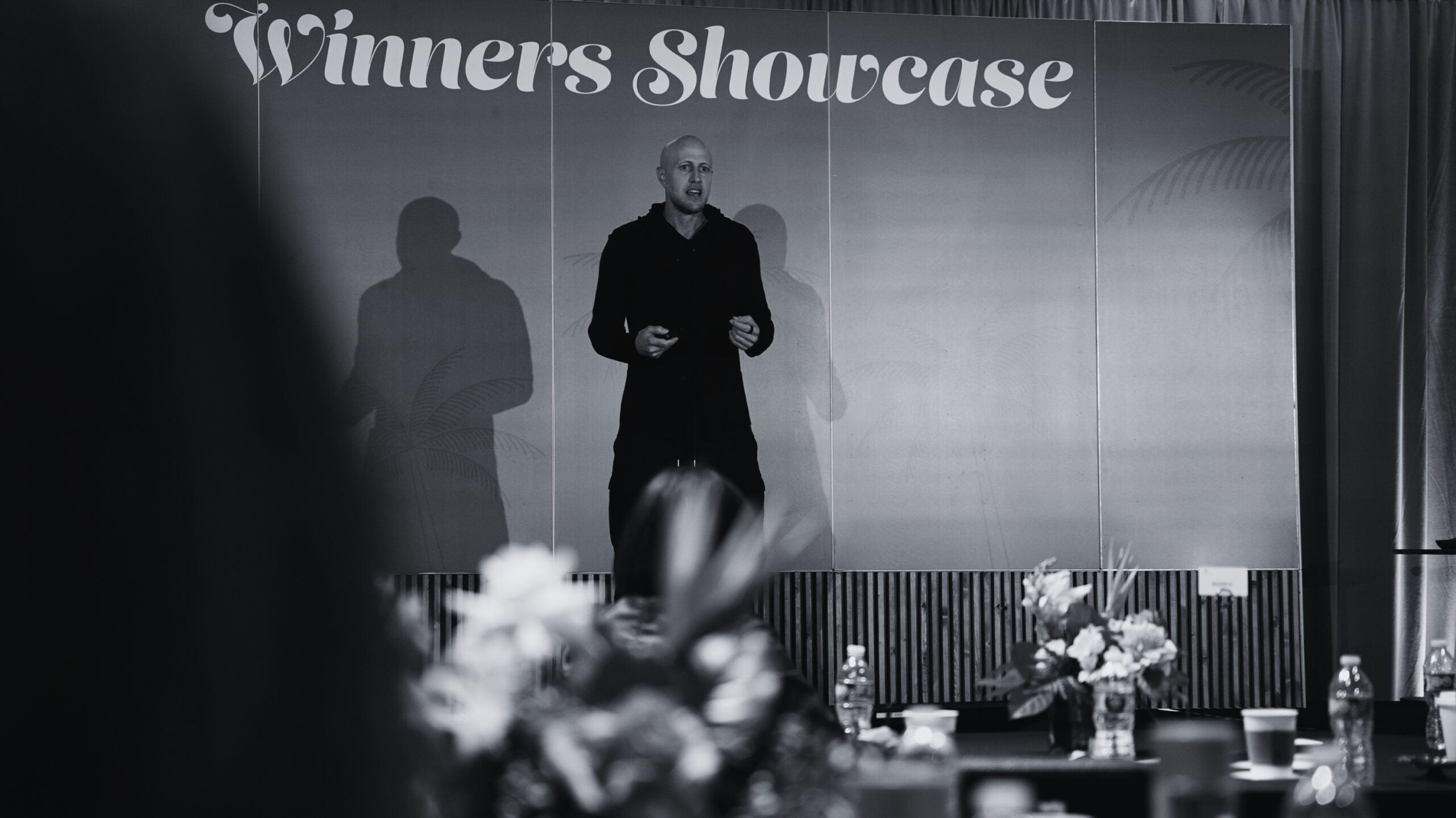


Most organizations measure performance in outputs — revenue, efficiency, execution. But beneath every output is a decision, a conversation, a moment of attention. Research shows the average professional is mentally present only 47% of the day, which means the most significant performance leak in most organizations isn’t strategy or resources — it’s fractured attention. Drawing on a live keynote session with business leaders in Miami, this article examines why presence is emerging as the foundational leadership skill of this era: why sustained awareness outperforms raw focus, what mindfulness practice actually does to decision quality and daily output, and why the leaders who learn to return their attention to the present moment — again and again — are the ones who perform when it counts most.
The W in Miami. A room full of business leaders and sales professionals operating at high volume, high stakes, and a pace that doesn’t slow down between January and December. People being asked — every single quarter — to do more with less.
I’ve been in a lot of rooms like this. And every time, before I say a word, I try to remember something: I’m not standing up there because I’ve mastered this. I’m up there because I’ve committed to doing the work — and because the work is worth sharing.
That’s the honest starting point. I’m not delivering this from some pedestal. I’m in the middle of the same lived experience — navigating the noise, catching my own mind somewhere other than where I am, and practicing the return to the present moment. Over and over again. What I can offer is a framework that helps, and the research that backs it up.
So that’s where we went.
The Number Nobody Wants to Admit
Here’s the thing about performance conversations at the executive level: we talk a lot about output. KPIs. Revenue. Efficiency. But we rarely talk about what’s actually driving — or draining — all of it.
So let’s start there.
Harvard research found that the human mind wanders nearly 47% of the day. That’s not a bad day. That’s the average. That’s what’s happening right now — in meetings, on calls, in one-on-ones — for almost half of every hour.
Measure that against a 40-hour workweek.
You’re getting about 20 hours of real, deliberate, work out of 40.
The other 20? Somewhere else. Replaying yesterday. Anticipating tomorrow. Toggling between 17 open Chrome tabs instead of two.
And when organizations are already squeezed on resources, on headcount, on time — losing half the available attention of every person in the building isn’t a footnote. It’s the problem.
What No Calendar Fix Can Solve
The calendar will stay full. The pressure isn’t going anywhere. And no amount of restructuring or productivity hacking changes the fact that performance is a human problem before it’s an operational one.
That was the heart of what we explored in Miami.
Not doing more. Showing up differently to what’s already on the plate. Closing the gap between being in the room and actually being in the room.
At the most basic level — mindfulness is a practice that helps us access the power that lives in the present moment.
That’s it.
Not some abstract woo woo concept. A real, trainable skill that neuroscience now confirms can physically reshape how the brain processes attention, regulates stress, and recovers from distraction. The research has caught up to what high performers — like the Navy SEALS, elite athlete and visionary CEOs — have known intuitively for a long time.
Sustained Awareness Is the Skill Everyone’s Missing
Peak performance isn’t just about the ability sustain focus.
It’s about sustained awareness — knowing when your mind has drifted and having the muscle to redirect it back. Back to the email. Back to the Zoom. Back to the client sitting across from you who deserves more than a version of you that’s half somewhere else.
I say this not as someone who has mastered it. I say it as someone who practices it — and who has seen the difference it makes when I do.
What Meditation Actually Does to Your Day
Here’s the part that tends to stop people:
Meditation doesn’t take time. It buys it back.
When you build even a short practice at the start of the day — creating presence before the noise begins — you carry that state with you into everything that follows. You arrive at the first meeting actually there. You move through the afternoon with more presence and less distraction.
Research from Johns Hopkins found that mindfulness meditation produces measurable improvements in anxiety, depression, and stress response — comparable in some cases to what medication delivers for those conditions. This is not soft. The data is serious.
For leaders, that morning investment shows up in decision quality. In how a difficult conversation lands. In whether the person on the other end of a call feels your full attention or senses they’re competing with your inbox.
I feel the difference on the days I miss my practice. That’s what keeps me coming back.
The Moment After the Session That Stayed With Me
After we wrapped, one of the leaders came up and we started talking.
He wanted his kids to know — really know — that when he was with them, he was with them. Not that he was in the same room as them while doing something else. He put it simply: he wanted to be present with them, not just physically nearby while his mind was somewhere else.
That one hit me.
Because I’ve felt that too — with the athletes and leaders I coach, and with my niece. There’s a version of showing up where your body arrives but your attention is somewhere else entirely. And the people you’re with know it. They feel the difference between your presence and your proximity. And, that’s what elevates your influence and ability to impact.
Presence isn’t a leadership skill you leave at the office. The same muscle that holds your attention on a client is the muscle that puts the phone down at dinner. The same awareness that catches a distracted moment in a board meeting catches you drifting during a bedtime story.
Research published in Psychological Science found that the quality of attention we bring to close relationships directly affects the wellbeing of the people we care about most — not just our own. Our presence, or absence of it, registers. They feel it.
That’s the conversation I didn’t expect to be the one that stayed with me longest. But it was.
Why This Has Become a Business Priority
It’s worth naming the organizational dimension of this, because it’s significant.
McKinsey and Deloitte have both moved well-being and attention management from HR talking points to strategic priorities. Gallup estimates that disengagement costs U.S. businesses roughly $550 billion annually. At the center of that disengagement is the same problem the Harvard study surfaced — minds that are checked out, even when bodies are checked in.
The leaders who came through that session in Miami didn’t walk away with a new framework to roll out. They walked away with something more immediate — a shift in how they relate to the pace they’re already living at.
One of them said it simply on his way out:
“I’m walking away a better person.”
That’s the bar I’m always shooting for. And honestly, it’s the bar I hold myself to too.
The Practice Beneath the Performance
Returning your attention to the present moment — to the email, the conversation, the meeting, the person in front of you — is not a passive act. It’s a decision made again and again, throughout the entire day.
That’s what this practice looks like in a high-performance context. Not silence. Not retreating from the pace. Building the internal capacity to meet the pace without losing yourself inside it.
The external world isn’t changing. Our relationship to it can.
That’s the work. And I’m doing it right alongside everyone in the room.