

The Seven Seconds That Reveal a Leader
Seven seconds remain on the clock.
The coach calls timeout, pulls out the board, and draws up one final play. The ball is coming to you to make a play.
You can hear the crowd. Your chest tightens. Your breath climbs higher. Every eye in the building seems to land on the same spot.
There is no time to become a better player. No time to add another move or study another page of the playbook. The work has already been done.
Your job is to become present enough to access it.
One steady breath. Feet on the floor. Eyes on the coach. The noise recedes just enough for your training to take over.
Leadership has its own version of those seven seconds.
You are running an executive meeting when someone shares news that could erase six months of planning. Before the person finishes speaking, you feel the shift: pressure in your chest, a shorter breath, your mind goes blank.
What happens next may shape the next six months.
You can fire back and make transparency less safe in every meeting that follows. You can force a decision because uncertainty feels unbearable. Or you can notice what is happening inside you, create a small amount of space, and respond from the part of you that has prepared for this moment.
That space is not passive. It is a performance skill.
Strategy matters, but strategy cannot help a leader who loses clarity when the pressure rises.
Regulation and capacity are not the same skill
Two abilities determine how much of yourself you can access under pressure: nervous system regulation and nervous system capacity.
Regulation is the ability to change your physiological state while an event is unfolding. It may begin with something as simple as slowing your breathing, relaxing your jaw, or feeling your feet against the floor.
A systematic review of 58 controlled breathing interventions found that most of the studied practices reduced stress or anxiety. A separate review of slow-breathing research connected the practice with changes in autonomic activity, including higher heart-rate variability.
Breathing does not solve the strategic problem in front of you. It helps you meet that problem with more of your cognitive ability available.
Stress can inhibit activity in the prefrontal cortex, the area involved in self-awareness, focus and decision-making. As the American Psychological Association explains in its review of stress and decision-making, that can push people away from goal-directed thinking and toward habitual or impulsive action.
A breath can interrupt that pattern.
Capacity is different. It is the amount of discomfort, ambiguity, emotion, and internal tension you can experience without being driven by it.
Regulation helps you settle the body. Capacity helps you stay in the room despite what your body is telling you.
A leader can learn a breathing exercise in minutes. Learning to remain open while disappointed, embarrassed, angry, or afraid takes longer. That work asks you to feel the emotion without handing it control of the meeting.
When capacity grows, leadership capacity grows with it.
I spent years trying not to feel
This has been some of the hardest work of my life.
I took antidepressant medication for 14 years, including years when I was still learning how to recognize and work with emotion. I also found other ways to disconnect. Many of them involved late nights on Brady Street in Milwaukee.
When I stopped taking the medication, under medical care, feelings arrived with an intensity I did not know how to hold. Antidepressant withdrawal is real, although its timing and severity vary widely. A recent clinical review of antidepressant discontinuation notes that much about the underlying biology remains unresolved and that tapering should be tailored to the individual.
For me, the experience felt like being traded midseason and not knowing our team plays. The sensations were mine, but I could not understand them.
Meditation and yoga had also begun bringing old pain closer to the surface. I had asked to become more aware. I was not prepared for everything awareness would show me.
Then I heard the claim that an emotion lasts only 90 seconds if we do not keep feeding it with thought.
So I tried to feel the emotion or sensation until it dissipated.
Ninety seconds sounds brief when you are calm. When an unfamiliar emotion seems lodged in your neck, chest, and shoulders, it can feel endless. I would sit with a feeling, wait for it to pass, and become frustrated when it stayed.
Eventually I saw the problem: I was trying to feel the emotion and get rid of it at the same time.
That is not acceptance. It is another form of resistance.
I later learned that the 90-second claim is not a rule supported by emotion research. Feelings do not run on a fixed timer. How long they last depends on the situation, the meaning we give it, the memories it activates, and how we respond.
Research also shows that managing emotion is not a simple contest between the rational and emotional parts of the brain. A 2024 study in Nature Neuroscience found that reframing an emotional experience involves several brain systems working together.
The practical lesson is simple: do not judge yourself because a difficult feeling lasts longer than 90 seconds. The goal is not to beat the clock. It is to build the ability to experience the feeling without letting it choose your next move. Sometimes the practice is to just sit with the emotion even if it never dissipates. You’re still training the skill. Eventually the emotions will dissolve, and on the other side is freedom, presence, and clarity.
The workout was working—until it wasn’t
For years, exercise was my answer.
I would push feelings down until they grew too large to ignore. Then I would train hard enough to exhaust myself. The emotion seemed quieter afterward, but I had exhausted myself so much through exercise I had no cognitive capacity for work.
Exercise is good for the brain and body. It can also become a way to escape an experience we have not learned to face.
The test is the intention.
Am I moving because movement supports me? Or am I trying to outrun what I feel?
The same question applies to breathwork. A breathing practice can help you settle. But if every breath carries the command, “Get this feeling out of me,” the fight continues.
Research on mindfulness points to the missing piece. In a randomized controlled trial on stress resilience, training people to monitor their present experience reduced stress only when the training also taught acceptance. Attention alone was not enough.
A later randomized trial of mindfulness during acute stress found that people trained in both monitoring and acceptance noticed more positive experiences during a stressful task. They did not report fewer negative experiences. They became able to perceive more of what was present.
That is capacity.
The goal is not to feel less. It is to stay in the seat of your higher-self when strong feelings arrive.
The body speaks before the leader reacts
Many leadership failures begin quietly.
A clenched jaw. Pressure in the throat. A foot tapping under the table. An urge to interrupt. A need to immediately solve a problem.
These signals often appear before the sharp comment, the rushed judgment, or the email sent too soon.
Treat them as information.
The earlier you notice a signal, the less energy it takes to work with it. That is why awareness belongs in conversations about executive performance. It gives a leader access to the few seconds between a stressor and your response.
Here are five steps for the next time pressure hits:
Name the signal. Silently identify what is happening: “My chest is tight.” “My breathing is shallow.” “I feel defensive.”
Lengthen the exhale. Take a quiet breath that does not turn the meeting into a performance. Let the exhale run slightly longer than the inhale.
Make room for the feeling. Do not demand that it leave. Let it be present without treating it as an instruction.
Return to the room. Feel your feet. Look at the person speaking. Listen for the facts beneath your reaction.
Choose the next useful action. Ask a question. Request more data. Call a short break. Say, “I need a minute before I answer that.”
This is not emotional suppression. It is emotional range.
A 2024 systematic review of executive function and resilience found links between resilience and cognitive abilities such as working memory, inhibition, and mental flexibility. Those abilities matter because pressure rarely announces itself in a convenient form. It arrives while you are listening, deciding, and being watched. Which is why it’s crucial to practice in the small moments just as much as the big ones.
Your team experiences your nervous system
People do not judge a leader only by the decision that gets made. They notice how that leader makes it.
Can bad news be shared without punishment?
Can disagreement exist without the room becoming unsafe?
Can the leader remain steady without becoming cold?
Can they acknowledge emotion without making everyone else manage it for them?
The answers become culture.
A regulated leader is not always calm. Calm can be an act. A regulated leader is aware enough to choose a response that fits the moment.
That may mean slowing down. It may mean setting a hard boundary. It may mean admitting that the news hurts and asking the team to work the problem together.
Presence does not remove intensity. It allows you to channel it.
What to seek in a leadership keynote speaker or executive coach
When leaders search for a leadership keynote speaker, the deciding question should not be, “Will this person energize the room?”
Energy fades.
Ask whether the speaker gives people a skill they can use when the next difficult moment arrives. Can they connect the research to the reality of a boardroom? Can they relate stories to your lived experience? Can they help leaders practice under pressure, not merely talk about it?
The same standard applies when choosing an executive coach for leaders. Good coaching should increase your awareness of the patterns that appear when the stakes rise. It should help you catch them earlier, widen what you can tolerate, and make choices that match the leader you want to be.
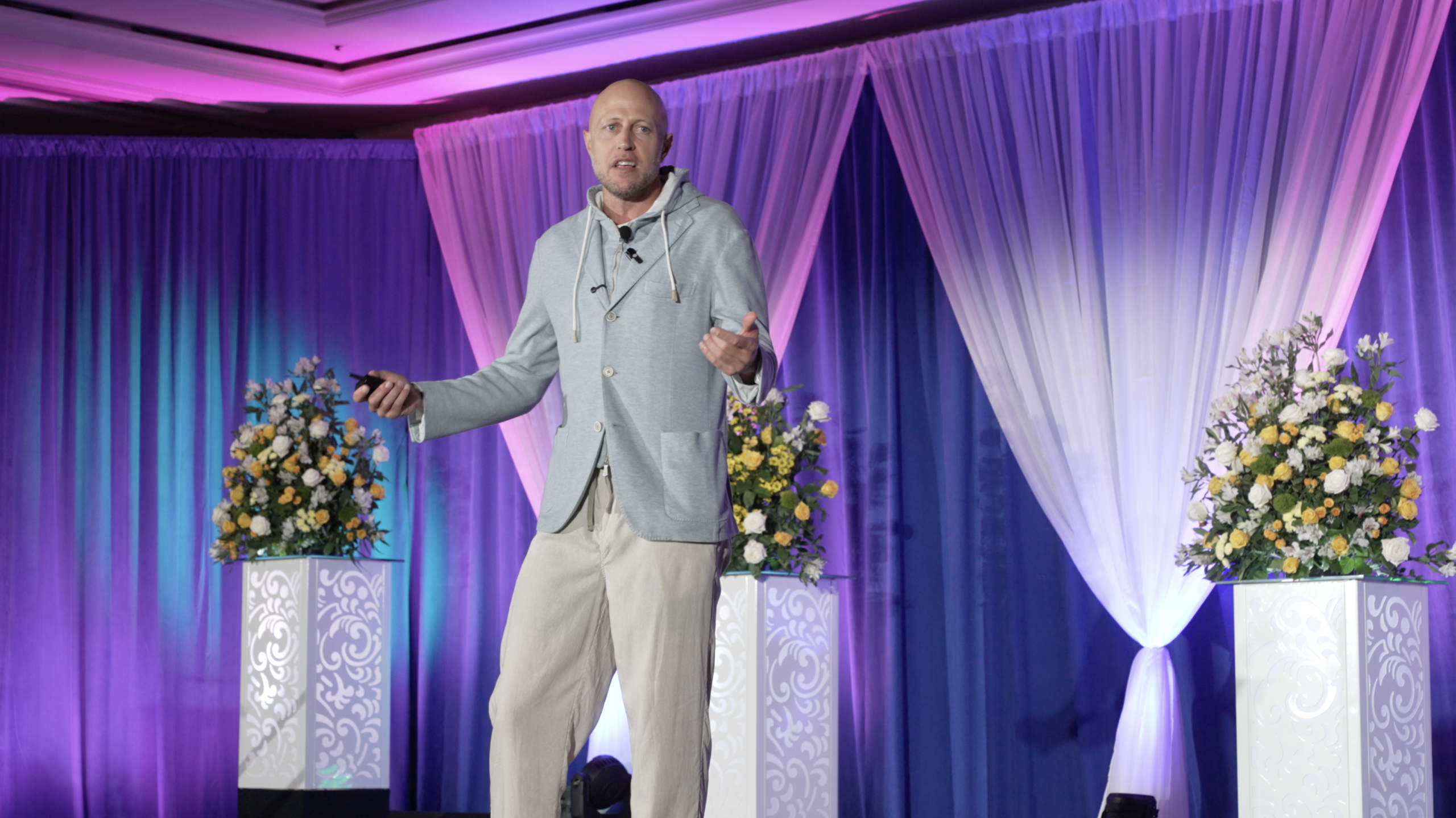
That is the work at the center of my Power of Presence keynote and my leadership coaching.
Because your training, intelligence, and values only matter when you can access them.
Seven seconds on the clock.
Bad news on the table.
Pressure in your chest.
The moment does not ask whether you know how to lead.
It asks whether you can access the leader you have trained to become.
Frequently Asked Questions
What is nervous system regulation for leaders?
Nervous system regulation is a leader’s ability to notice rising physiological arousal and respond in a way that supports clear thinking. Practices may include paced breathing, grounding, naming a sensation, pausing, or reframing an event.
How does nervous system regulation improve leadership?
It can create more space between a stressful event and a leader’s response. That space supports listening, judgment, emotional control, and behavior that builds trust.
What is the difference between regulation and nervous system capacity?
Regulation changes the intensity of your current state. Capacity is your ability to remain present with difficult emotion or uncertainty without reacting automatically. Leaders need both.
Can a leadership keynote teach nervous system regulation?
A strong leadership keynote speaker can introduce the science, lead practical exercises, and give teams shared language for pressure and presence. Continued practice or coaching helps turn those lessons into dependable behavior.
How can executive coaching help leaders perform under pressure?
Executive coaching helps leaders identify their stress patterns, notice physical warning signs, and rehearse better responses before the next high-stakes decision. The aim is not constant calm. It is greater choice when pressure arrives.
Looking for a leadership keynote speaker who can help your people perform under pressure and win the moments that matter? Explore Mike Lee’s leadership keynotes or start a conversation about executive coaching.