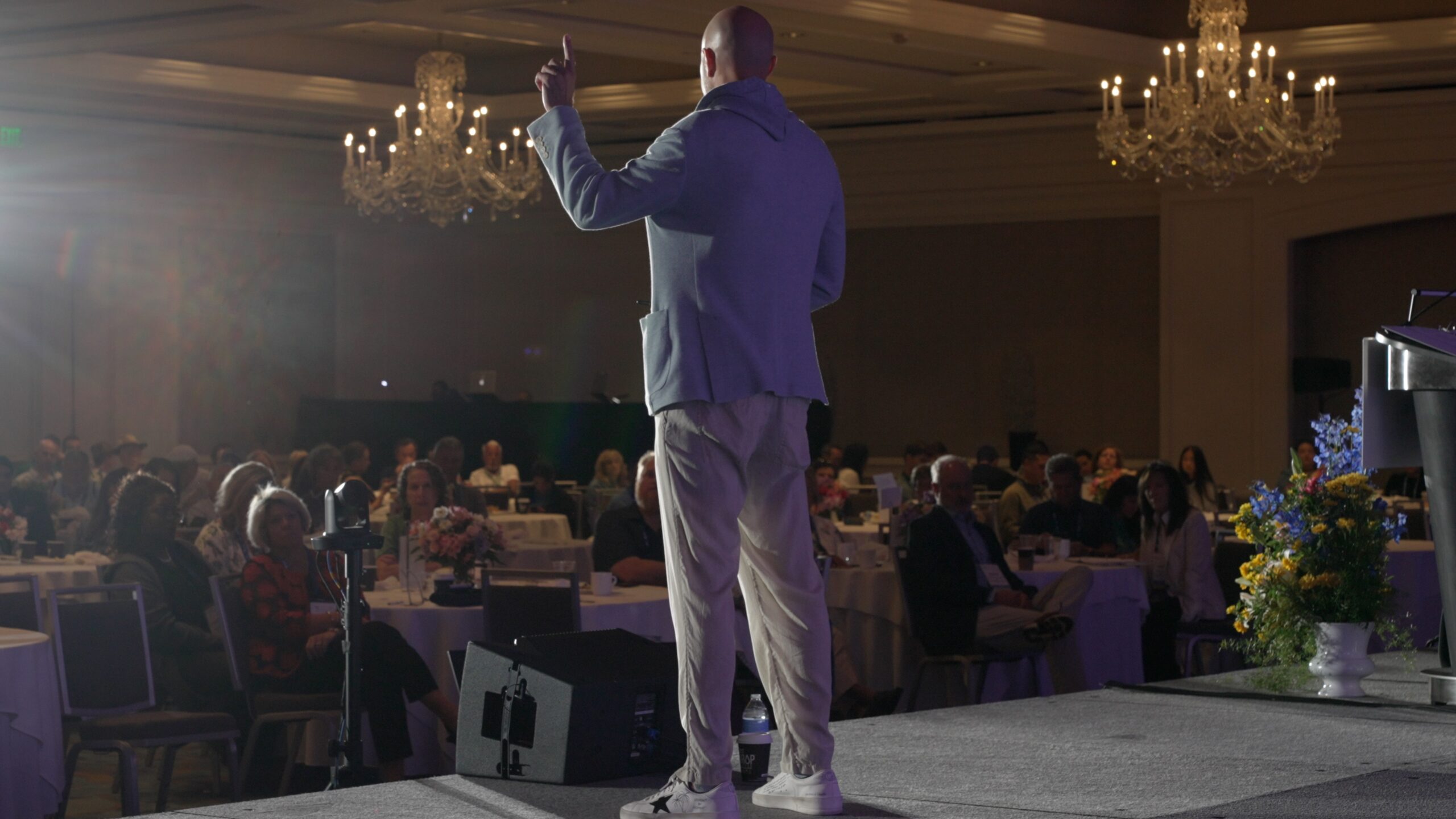


AI and technology can be copied in a second. The mind they came from cannot. As access to knowledge becomes nearly universal, a leader’s advantage shifts inward—to the beliefs, habits, attention, and emotional skills they can access under pressure. Drawing on years alongside basketball’s elite, including Stephen Curry, Joel Embiid, and dozens of NBA players and coaches, Mike Lee introduces five practices at the center of The Architecture of Presence: lead with a beginner’s mind, train attention, trust the process, prepare for pressure, and create space between a trigger and a response. Supported by research on mindfulness, stress, critical thinking, and decision-making, these practices help leaders move through distraction and uncertainty with greater focus, clarity, and intention.
What years alongside basketball’s elite taught me about attention, uncertainty, and the moments that decide everything
I have spent years on basketball courts with some of the best players in the game, including Stephen Curry and Joel Embiid, as well as dozens of other NBA players and coaches.
People usually want to know what separates them. The shooting? The footwork? The size? The hours in the gym?
Those things matter. What stays with me, though, is what great players do after a miss, turnover or mistake on the court.
The crowd reacts. The scoreboard changes. A coach calls the next action, and ten people start moving at once. There is no time to hold an internal meeting about the last possession. The player has to get to the next play.
I see leaders struggle with the business version of that moment every week. A product launch slips, a customer walks, or the board wants an answer. Before there is time to process any of it, the next meeting starts and three more messages arrive.
That is leadership under pressure: staying in the present moment and making the call when it matters.
It is also the idea behind The Architecture of Presence, a keynote about staying focused and grounded when the pressure and noise around you make that seem unbearable.
The Edge Isn’t Another Tool
Every few weeks, new software promises to help us move faster, produce more, and make better decisions. Some of it is incredible. Your competitors can buy it too.
That makes technology a temporary advantage. The deeper edge is built inside the person using it.
I learned this through basketball. At the highest levels, everyone studies film, knows the playbook, and has access to great coaching. When the game gets tight, the difference is the inner game: the belief to recover after a mistake, the habits a player can trust under fatigue, and the emotional control to stay connected to the next possession.
Leadership works the same way.
Microsoft Research studied 319 knowledge workers using generative AI. Greater confidence in the technology was associated with less critical thinking. Greater confidence in one’s own ability was associated with more questioning and independent judgment.
AI can supply information. It cannot build your self-trust, train your habits, or regulate your emotions when the pressure rises.
The tool may change how you work. Your inner game determines how well you use it.
What Distraction Looks Like in a Leadership Meeting
The problem is not that leaders suddenly became less intelligent. Their attention is being divided all day.
Harvard researchers Matthew Killingsworth and Daniel Gilbert found that people were thinking about something other than what they were doing during 46.9% of the moments sampled.
Once you know that number, it is hard to look at a meeting the same way. Eight leaders may be sitting at the table, but one is replaying yesterday, another is preparing a rebuttal, and someone else is worrying about a result that has not happened. Their bodies made it to the meeting. Their attention is moving between several different places.
Most organizations treat distraction as a calendar problem. They shorten meetings, silence notifications, and block time for focused work. Those changes help. They do not touch the distraction that comes from fear, defensiveness, impatience, or the emotional residue of the previous conversation.
You can close every tab on your screen and still have twenty open in your head.
Presence starts when you notice that your attention has moved. From there, you can bring it back to the work or the person in front of you. Some days that happens easily. Other days I have to do it repeatedly in the same conversation. That repeated return is the practice.
The Architecture of Presence
Over time, I found five practices that helped me on the court, in business, and during periods when my own mind was difficult to manage. Together, they form what I call the Architecture of Presence.
1. Lead With a Beginner’s Mind
One of my mentors was an NBA coach who was about 30 years older than me. Even with decades of experience, he would come to the gym and watch me work out high school players.
He understood that the game could change almost overnight. If he decided his experience meant he had everything figured out, it would eventually become the thing that held him back.
I saw that same quality in the coaches and players who kept growing. They asked questions. They adjusted when the game changed. They did not confuse past success with permanent expertise. The best were confident enough to lead and humble enough to remain students.
A beginner’s mind does not require a leader to forget what they know. It asks them to hold their current answer a little less tightly. Research on intellectual humility from Duke University psychologist Mark Leary and colleagues connects it with curiosity, openness, tolerance for ambiguity, and closer attention to the strength of an argument.
For a leader, that can be as practical as entering a meeting ready to ask what has changed before defending the old plan.
2. Train Attention for a Distracted Workplace
Mindfulness works directly on the skill every leader is fighting to protect: attention.
Each time your mind wanders and you bring it back, you are practicing the same move leadership demands all day. Return to the person speaking. Return to the decision in front of you. Return to what you can control after a mistake, distraction, or emotional reaction pulls you somewhere else.
The research on that practice is extensive. A meta-analysis of 111 randomized controlled trials involving 9,538 people found meaningful gains in executive attention, working-memory accuracy, inhibition, cognitive flexibility, and sustained attention.
The effects also reach beyond focus. A workplace meta-analysis covering 91 studies found improvements in stress, well-being, mental health, and work-related outcomes. These are not separate from performance. They shape how well a leader listens, adapts, communicates, and makes decisions when demands start stacking up.
I teach this only because I was a student first.
During the withdrawal process from an antidepressant medication, I could shift from crippling anxiety to debilitating depression within a matter of hours. My ability to focus disappeared. The present moment felt inaccessible, and so did much of the work I cared about.
Mindfulness gave me something concrete to practice. I could notice where my mind had gone, reconnect with my breath and body, and bring my attention back to what was happening. Over time, those repetitions helped me rebuild my capacity to stay present with difficult emotions without being completely carried away by them.
That same capacity shows up in leadership. It helps you remain in a hard conversation, recover after a mistake, recognize when emotion is influencing a decision, and give another person your full attention.
Mindfulness does not remove pressure. It trains the part of you that has to meet it.
3. Trust the Process
My experience with my Oura ring made me much more aware of how I think about the process.
When I first started using it, I found myself checking the data after meditation sessions and evaluating whether the session had been “good” based on the score. The measurement was meant to help me build a healthier practice, but it also created a new distraction: I was paying more attention to the result than to the experience itself.
Leaders are paid to care about results, so it makes sense that revenue, retention, and deadlines occupy a lot of mental space. Trouble starts when the result takes so much attention that we lose contact with the work capable of producing it.
I have watched leaders stare at a quarterly number while sitting in the customer conversation that may shape it. I have done my own version of that by wondering if leads are going to close instead of doing the work to get more leads.
On a basketball court, the scoreboard gives useful information, but it’s not what you focus on. You still have to know the scouting report, focus on one possession at a time and take care of the basketball. Leadership works the same way. Keep the outcome in view, then come back to the question, conversation, or decision you can act on now.
To me, trusting the process is the practical discipline of placing attention on the work within reach.
4. Perform Under Pressure
Pressure changes the way people use their attention. Smart teams can start rushing, defending old positions, or grabbing the first answer that reduces discomfort.
A 2025 experiment published in Communications Psychology found that acute stress impaired decision performance as task complexity increased. The difference became clearest on harder problems that demanded more from attention and working memory.
Leaders cannot remove every source of pressure, but they can prepare before a hard moment arrives. Athletes rehearse situations, build routines, and return to a few familiar cues. Before a difficult conversation, a leader can do something similar: picture the room, anticipate where emotion may rise, and decide how they want to respond if it does.
Mental rehearsal leaves room for spontaneity while making the situation familiar enough that your first encounter with it does not happen when the stakes are highest. You walk into the room experiencing it as if you’ve already been there.
5. Expand the Decision Gap
When I coached basketball, I had a rule for myself: never yell at a player until I had asked how their day was going.
I learned that what looked like low effort could have context I was not seeing. Asking the question gave me a better read on the person before I decided how to coach them. I shared that rule in an article about leading people when they are exhausted.
That pause is the Decision Gap—the space between what happens and what you do next. Without it, an email lands, a comment hits a nerve, or a plan breaks, and the body begins responding before the mind has gathered the full story.
Awareness gives a leader time to notice the tight chest, the conclusion forming, or the urge to answer immediately. A 2024 systematic review and meta-analysis of 110 studies found that mindfulness-based strategies had a small but measurable effect on emotional regulation. The authors also found that acceptance of an event or stressor was more effective than monitoring alone. Whatever we psychologically resist will continue to persist. Acceptance creates space so we can get objective before making the decision on how to move forward.
What People Should Carry Out of the Room
I do not expect a keynote to solve an organization’s problems in an hour. I do expect people to leave with language and practices they can use when Monday gets difficult.
After The Architecture of Presence, leaders know how to:
- Question an old assumption without surrendering conviction.
- Catch their attention drifting and return it to the task or person in front of them.
- Move attention from an uncontrollable result to the next useful action.
- Prepare mentally for a high-pressure conversation or decision.
- Put space between a trigger and their response.
The session is built for senior leaders making high-stakes decisions, managers working to reduce reactivity on their teams, and organizations that want steadier performance without keeping people in a constant state of strain.
I draw from my years working alongside basketball’s elite, my own experience with anxiety, depression, and a serious health crisis, and research from neuroscience, mindfulness, emotional intelligence, and performance psychology. The basketball stories make the mental work visible, but the application belongs in meetings, sales conversations, executive decisions, and the interactions that shape a culture.
The Conversation After the Keynote
After a recent session with a room full of business leaders, one of the leaders came up to talk with me. He did not ask about productivity or decision science. He talked about his kids.
He wanted them to know that when he was with them, he was really with them—not sitting nearby while his mind remained at work. I understood exactly what he meant. There is a difference between being physically close to someone and giving them your attention, and the people closest to us can feel it.
That conversation stayed with me because it brought the business case for presence back to something personal. The same attention that helps a leader hear what is not being said in a meeting also helps a parent put the phone down at dinner. We do not become different people when we leave the office. We carry the quality of our attention with us.
The market will continue to change, and pressure will keep arriving before every team feels ready. We may not control the timing, but we can practice how we meet the next conversation, decision, or possession.
If your leaders are dealing with distraction, uncertainty, and pressure, explore The Architecture of Presence, read what event leaders and executives say about Mike’s programs, or start a conversation about your event.
Is This the Right Keynote for Your Event?
The Architecture of Presence is a keynote on focus, uncertainty, intentional decision-making, and performance under pressure. It is designed for senior leaders, executives, managers, sales leaders, and teams that need to think clearly and adapt in demanding conditions.
Mike Lee is a #1 bestselling author, leadership coach, and Top 50 keynote speaker. His work draws on years alongside NBA stars including Stephen Curry and Joel Embiid, current research, and his personal experience moving through adversity.
Participants learn five practices: keep a beginner’s mind, train attention, stay close to the process, prepare for pressure, and expand the space between a trigger and a response.